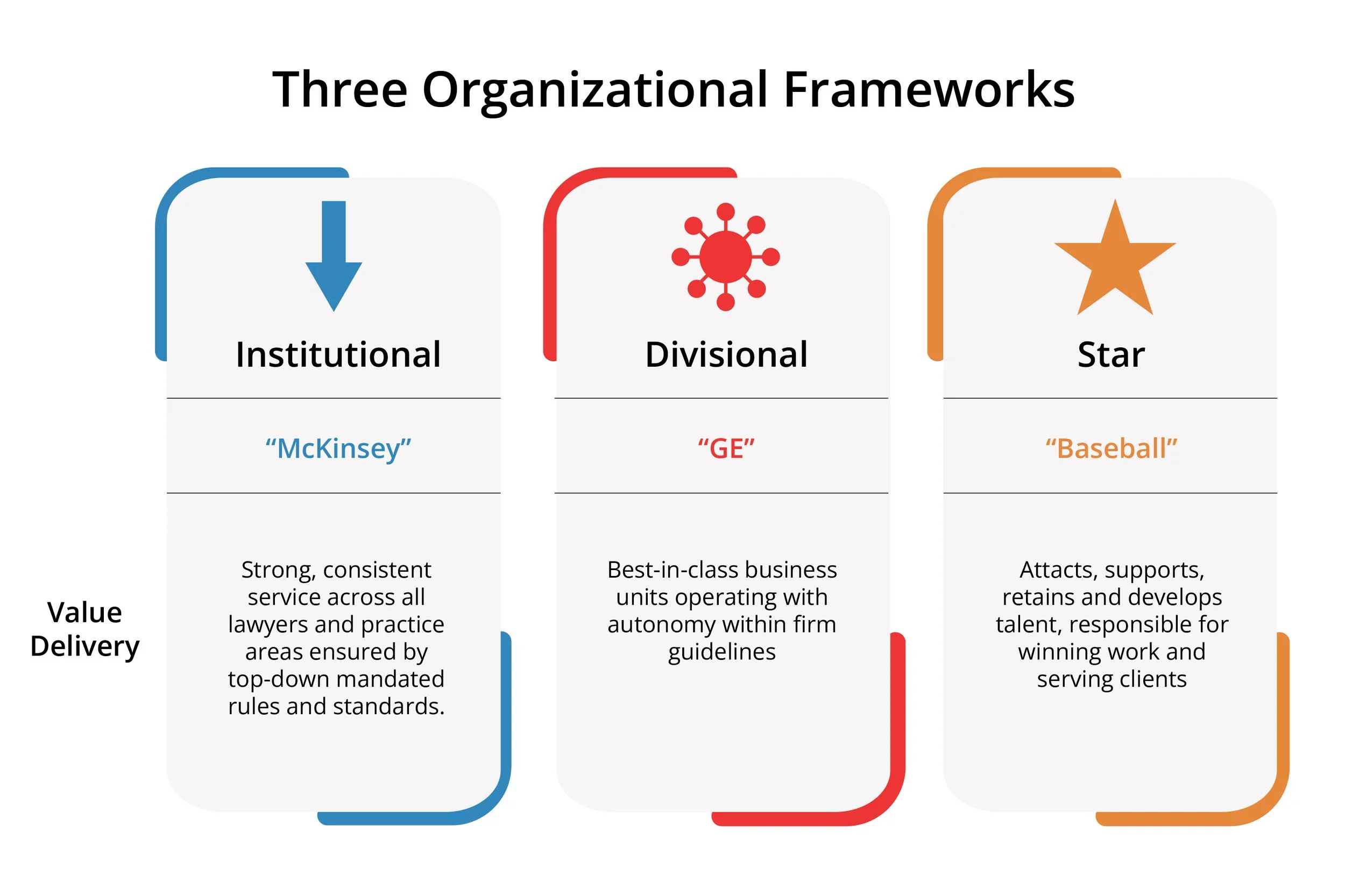
While all professional services entities share the same primary mission, delivering value to internal or external clients, their organizational model dictates the optimal means of achieving this mission. Management strategies and tactics that conflict with your organizational model’s ecosystem are destined to fail.
The three primary organizational models are: Pyramid (Institutional), Star (Talent), and Hub & Spoke (Business Unit). Deeply understanding your firm’s ecosystem will greatly increase the success of your practice management and growth initiatives.
The Pyramid (Institutional) Model
Institutional entities deliver value through a top-down pyramid structure that produces shared practice and behavioral attributes across all professionals, practice teams, staff and offices. Leadership sets the strategy, culture and style of practice, strongly influenced by history and tradition. Institutional entities tend to be highly collaborative with clearly articulated missions and values. Their strengths include a proven ability to develop and implement a focused strategy and invest in high-value activities. Their leaders tend to be senior statesmen/women. Institutional firms have a more formal internal structure with greater clarity in the allocation of responsibility and accountability.
The highly directive, top-down leadership and management style of institutional firms leads to more focused areas of practice with higher leverage and fewer geographic locations. There is far greater formalization and standardization of how services are performed and delivered, helping such firms build brands around excellence and quality. The length of the average client engagement tends to be longer and higher value as measured by the seniority of the client contacts, the duration of the relationships and the sophistication of the work.
Institutional firms place an intensive emphasis on client relations. Clients are clients of the firm as opposed to a particular partner or practice. There is a strong focus on developing practices with scale, tailored to the needs of particular clients or markets. Clients tend to be larger companies seeking the consistent quality that institutional firms can deliver across their range of practices. Client relationships tend to be long-standing and exist across the highest levels of the client organization. Part of the appeal of institutional firms is their finely honed ability to provide a combination of generalist “trusted advisor” services and high-level specialist capabilities. Institutional firms are less focused on growth in size and prefer internal growth to growth by talent acquisition or mergers. For practice growth, they prefer providing new services to existing clients and markets and expand more slowly to new markets.
Institutional firms are highly focused and strategic environments that foster collaboration and high-quality work product and service. Their focus on continuous research and development and willingness to make investments helps them lead the market in providing high-value services. These attributes also help them effectively prepare for and adapt to systemic, long-term market changes. They are typically the most profitable law firms.
The challenges of the institutional model can be that the high level of standardization of systems, processes and practices can drive away exceptional but unconventional lawyers, who seek greater autonomy and flexibility. This attribute also can limit their flexibility and ability to make fast, small shifts in strategy to take advantage of near-term opportunities. For example, they were not among the first firms to develop private equity or technology practices; far more agile firms developed the first strong footholds in those markets. Institutional firms tend to enter new markets at the direction of major clients.
The Talent Model
Talent entities deliver value to clients by organizing the firm to attract, retain, support and develop the best possible talent. Professionals are autonomous, self-directed, and entrepreneurial and leadership focuses on defining limited organizational rules and parameters, supporting high-performers and cultivating talent. Practice teams tend to have limited power and authority, and exist to help keep professionals operating within organizational boundaries.
Talent entity strengths include its diversity and flexibility. Management’s primary focus is bottom-line numbers, contributing to creation of an internal environment that is often highly competitive. The leaders of talent firms tend to be “star performers.”
The control systems of talent entities are metrics-based and results oriented. They have informal internal structures with limited clarity in the allocation of responsibility and accountability. Management decision-making tends to be highly decentralized and planning systems are primarily financial.
One of the limitations of talent firms, particularly in a rapidly changing market environment, is their limited commitment to research and development and their resistance innovating at the entity level.
The diffuse and flexible leadership and management style of talent firms leads to a more opportunistic and talent focused approach to strategy. Practice and operating groups are less powerful. Leverage and the length of engagements tend to be lower than those of other models.
Talent firms perform a broad variety of client work, at a wide range of margins, and have more geographic locations, which are driven by the needs of talent. There is very limited formalization and standardization of how legal work is performed and services are delivered, limiting the ability of such firms to deliver consistently high-value work across their platforms. The length of each client engagement tends to be shorter and relatively lower value as measured by the seniority of the client contact and the sophistication of the work.
At talent firms, client relations are mainly the purview of individual relationship partners since clients are considered to be clients of a particular partner or practice as opposed to the firm. There is an entrepreneurial focus on developing emerging practice areas as opposed to building practices with scale. Clients are generally a range of sizes and tend to provide single-service offerings to large companies and broader services to smaller companies seeking innovative and more flexible services.
Client relationships tend to be more transactional and exist across all levels of the client organization. Part of the appeal of talent firms is their deep roster of niche industry and practice specialists. Talent firms are highly focused on growth as a primary goal and are comfortable with the use of mergers. For practice growth, they tend to focus on providing the same services to new markets.
Talent firms are highly entrepreneurial environments capable of moving quickly to capture new market opportunities and address changes in economic conditions. The diffuse management and leadership style of these firms enables greater diversity of thought and flexibility in the delivery of services to clients.
The challenges of the talent model stem from the limited standardization of systems, processes and practices, which make it difficult to seamlessly and consistently deliver high-value services across their platforms, reducing the opportunities for branding at the firm level. Additionally, the lack of research and development and limited tolerance for overhead, create systemic challenges for talent firms seeking to compete for high-margin work.
The Business Unit Model
Business unit firms deliver value to clients by organizing the firm in best-in-class business units, most often called practice groups, operating with a high level of autonomy but within firm guidelines. In the business unit model, firm-wide leadership establishes overall goals, objectives and culture. Business unit leaders and managers develop and implement strategies appropriate to their business unit to support and achieve the firm’s goals. The lawyers execute business unit strategy to create and deliver value to clients and profits to partners.
Leadership’s focus is service-line superiority in the marketplace and decision-making occurs through a matrix structure. Business unit firm strengths include strong practice, industry and market knowledge, practice-level innovation, and the existence of high-functioning practice groups as teams. Firm leaders tend to be the top business unit leaders and their primary management function is to orchestrate the work of the business units and avoid the creation of silos.
The control systems of business unit firms are performance based and planning derives from a hybrid of metrics and subjective judgment. They have matrix internal structures with clear allocation of responsibility, accountability and territories between and among the business units. Internal transfer pricing (charge-backs of costs to practice groups, offices or regions) is extensive. Profit centers and measures are in place to monitor and manage business unit performance.
Among the strengths of business unit firms are their commitment to research and development at the practice level and their willingness to enable their practice groups to invest and take risks. These attributes enable business unit firms to lead the market in the provision of best-in-class services to clients.
Practice group performance forms the basis for compensation decisions in a business unit firm, followed distantly by individual contribution to practice group success and then firm results. Business unit firms have a variable high-to-low compensation dispersion, can have significant annual compensation adjustments, and often use rolling averages in determining compensation as a hedge against market condition impacts on particular practices.
The matrix leadership and management of business unit firms lead to variability and flexibility in all aspects of operations including the size, leverage and geography of these firms. Formalization and standardization of how legal work is performed and services are delivered exist at both the firm and practice group level, helping such firms build brands around best-in-class services. The length of each client engagement tends to be moderate and the value of client work can span the value spectrum as measured by the seniority of the client contacts and the sophistication of the work. The business unit model enables firms to tailor their services most closely to the needs of each client and the requirements of a legal matter.
Business unit firms place a strong emphasis on client relations both at the firm and practice group level. Clients are viewed as clients of the firm as well as clients of a particular practice. There is a strong focus on developing best-in-class practices with a deep specialist bench. Business unit firms are less focused on growth in size and engage in both internal growth and growth by talent acquisition or merger. For practice growth, they focus on both developing and delivering new services to existing clients and markets and expanding into new markets.
Business unit firms are highly focused and strategic environments that foster collaboration and high-quality work product at the practice group level. Their focus on matching service offerings to market and client needs and gives them a strong value proposition and competitive advantage. By enabling business decision-making and control closer to clients, business unit firms can engage in quick and informed decision-making and can rapidly develop new service offerings to meet market and client needs.
The challenges of the business unit model relate to eliminating the potential for practice groups to become silos, which can limit cross-selling and impact the firm’s brand. In addition, business unit conflicts can arise over resources, budget, talent assignments and client relationships. These issues can be mitigated through a combination of strong firm leadership, transparency and clear resolution mechanisms.